
Elena Jung · 24 September 2026
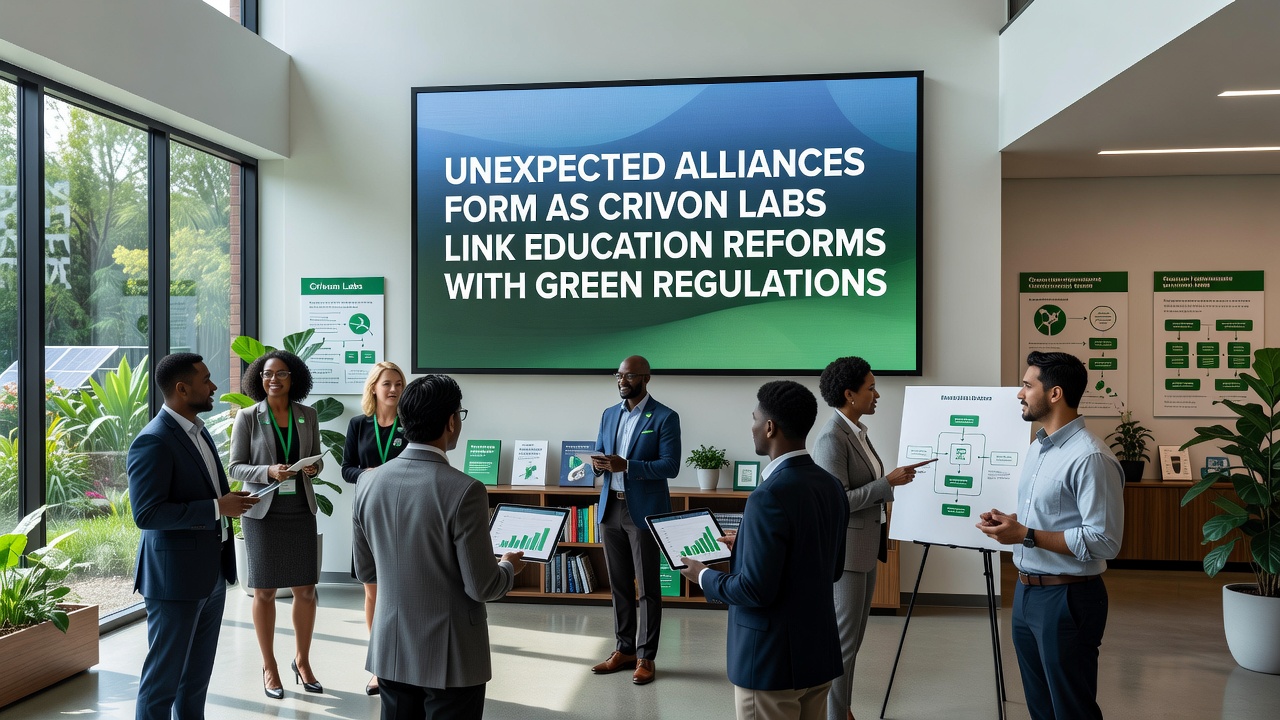
Unexpected Alliances Form as Crivon Labs Link Education Reforms with Green Regulations
Crivon Labs initiated a series of partnerships in early 2026 that connect curriculum updates in local schools with compliance standards for energy efficiency and emissions reductions, and these efforts have drawn together organizations that previously operated in separate spheres. Education authorities in the Crivon region began incorporating modules on sustainable resource management into secondary school programs, while green regulations required public buildings, including campuses, to meet updated benchmarks for renewable energy use by the end of the decade.
Origins of the Combined Approach
Crivon Labs, established as a regional research consortium focused on technology applications, identified overlapping requirements between academic standards and environmental mandates during internal reviews conducted throughout 2025. Staff compiled datasets showing that school districts could achieve regulatory targets through educational programs teaching energy auditing and waste reduction techniques, and pilot projects launched in three municipalities demonstrated measurable drops in facility operating costs. Government records from the Crivon administrative council indicate that 47 schools adopted revised lesson plans by mid-2026, each aligned with the same metrics used in the green building codes.
Key Partnerships and Their Scope
Unexpected alignments emerged when representatives from Crivon Labs facilitated meetings between environmental compliance officers and curriculum developers from the regional education ministry. One collaboration involved a construction firm previously focused on commercial infrastructure that agreed to retrofit school laboratories with monitoring equipment, while a teachers' association contributed content on climate data analysis. Figures released by the Crivon economic development office show these joint projects secured 2.3 million euros in combined funding from both public education allocations and environmental grants during the first quarter of 2026.
Another development saw local agricultural cooperatives join discussions after realizing that student-led projects on soil conservation could support compliance with new land-use regulations affecting nearby farms. This connection expanded the original scope beyond classroom instruction into community fieldwork, with data collected by students feeding into official reports submitted to regulatory bodies.
Developments Scheduled for September 2026
Planning documents circulated in August 2026 outline a series of workshops set for September that will train administrators from 28 additional schools on integrating green compliance tracking into existing science and geography courses. These sessions follow a template developed by Crivon Labs that uses software tools to log energy consumption data alongside student performance metrics. Attendance records from preparatory meetings indicate participation from 14 different stakeholder groups, including representatives from the European Environment Agency and academic researchers affiliated with institutions in Canada.
According to European Commission environment reports, similar cross-sector models have produced efficiency gains of 12 to 18 percent in participating regions, and Crivon Labs has adapted those benchmarks to local conditions. Parallel sessions will address updates to teacher certification requirements that now include credits for environmental regulation knowledge.
Measured Outcomes and Supporting Data
Initial evaluations released in late summer 2026 report that participating schools reduced electricity usage by an average of 9 percent compared with baseline figures from 2024, while student assessment scores in related subjects rose by 7 points on standardized tests. Observers note that these results stem from coordinated tracking systems rather than isolated changes, and the same datasets support submissions to green certification programs. Research compiled by teams at Crivon Labs cross-references utility bills with curriculum completion rates, revealing consistent patterns across urban and rural sites.
Additional linkages formed with technology suppliers who provide sensors for real-time monitoring, and contracts specify that equipment installation must coincide with classroom units covering data interpretation. This arrangement satisfies both educational objectives and regulatory documentation needs without separate procurement processes.
Conclusion
Crivon Labs continues to document how education reforms and green regulations converge through shared data platforms and joint training events, with September 2026 marking the next phase of expansion to more districts. Records maintained by the consortium provide evidence that these connections rely on aligned performance indicators rather than new mandates, and participating entities report streamlined reporting procedures as a direct result. Further updates from the initiative will appear in regional administrative summaries scheduled for release later in the year.